Let's start with a scene every parent knows.
Your kid is on the floor. Fully on the floor. Something happened involving a sock, or a sibling, or the wrong color cup, and now there is crying and there is kicking and there is possibly a noise you've never heard a human make.
And you, a loving and reasonable adult, crouch down and say the thing we all say: "Take a deep breath. Use your words. What's wrong?"
Nothing happens. Or it gets worse.
Here's the part nobody told us: your child isn't ignoring you. They can't hear you. Not in the way you mean. The part of their brain that answers "what's wrong?" has gone offline, and the body is running the show.
That's where somatic practice comes in. And if you just thought "what on earth is somatic," you're in the right place.
What "Somatic" Actually Means
Somatic just means "through the body." That's the whole word.
A somatic practice is anything that helps a person calm down by doing something with their body, instead of thinking their way out of it. Weight. Breath. Rhythm. Movement. Sound. Closeness.
You already do somatic practices every day. You just never called them that. The big sigh after a hard phone call. Shaking out your hands before you walk into a room. Your hand flying to your chest when something startles you. Rocking a baby. Humming in the car for no reason. Nobody taught you any of that. Your body knew.
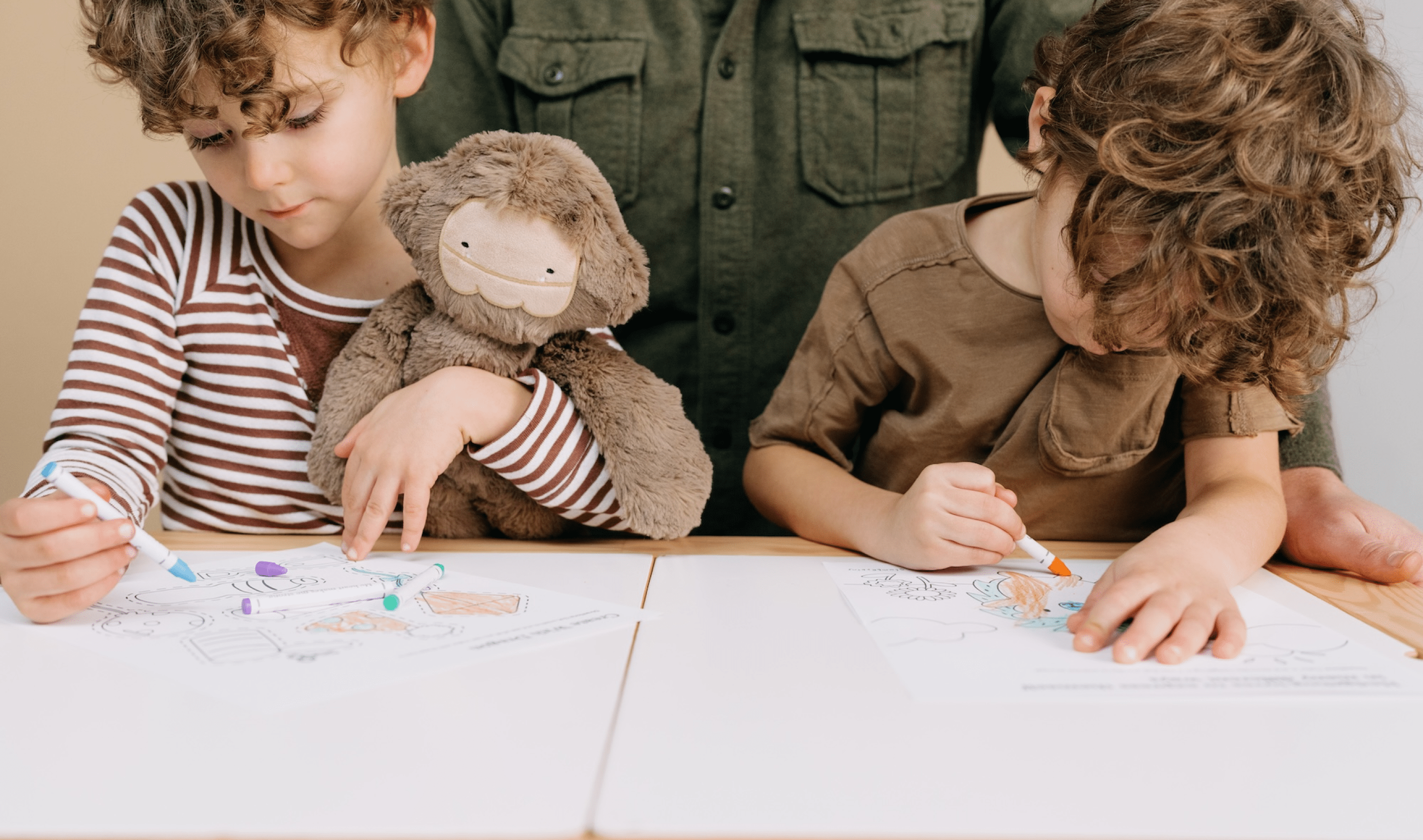
Kids' bodies know it too. Watch a preschooler after a long day at school. They don't sit down and process their feelings. They run laps around the living room. That's not misbehavior. That's a nervous system doing exactly what it was built to do.
We just decided to make it a little easier to reach for. That's what the weighted Capybara and the Calm With Me book are for.
Body First. Behavior Second. Words Last.
Here's the order of a meltdown, and it explains almost everything.
Step 1: The body senses first. A sound, a tone of voice, a look, a transition. It hits the nervous system before the thinking brain knows what it means.
Step 2: The body reacts. Heart speeds up. Muscles tighten. Breath gets short. This is protective, not bad. But once the body is activated, words get very hard.
Step 3: The body settles, or it doesn't. With a calm body nearby and some soothing input (weight, breath, rhythm), the system comes back to baseline. Without it, the activation stays stuck.
Most of us only ever learned one tool for helping a kid calm down: talking. Name the feeling. Reason with them. Explain why the cup is fine. That's what researchers call a top-down approach, and it works beautifully once the body is already calm (Siegel & Bryson, 2012).
Somatic tools work the other direction. Bottom-up. They calm the body first, so the words can come back later (van der Kolk, 2014). Talking is a top-down tool. It needs a calm body to work. Somatic moves are bottom-up. They create the calm body.
Why We Made Capybara Heavy
Every Slumberkin has a job. Capybara's job is to speak to the body before it speaks to feelings.
Capybara is weighted. Soft, heavy, and slow, built to rest on a belly or a chest and do quiet work while your child breathes. Weight tells the nervous system "you're safe here" faster than any sentence can. The softness invites the body to slow down. Held against the chest, it does something without asking
your child to explain anything (Porges, 2011).
You already know this from adult life. There's a reason weighted blankets exist. We just made a version a three-year-old can carry to the couch on purpose.
The Six Somatic Moves in Calm With Me
The Calm With Me book teaches six simple moves. Each one works on a different part of the nervous system, and each takes under a minute. The trick isn't doing all six. It's knowing which one to reach for.
1. Weighted Belly Breathing. Capybara on the belly. Breathe in through the nose and watch it rise. Breathe out through the mouth and watch it fall. In for 4, out for 6. Reach for it when: your child is winding down, can't fall asleep, or is ready to settle after a hard moment.
2. Shake It Out. Stand up together. Shake your hands, then your arms, then your shoulders, then your whole body for 30 seconds. Stop. Breathe. Notice what changed. Reach for it when: your child is tight, loud, fidgety, or full of stuck energy. (Watch a dog after a scare. They shake head to tail and then they're
fine. Same idea.)
3. Side-to-Side Leg Tapping. Sit together with Capybara on their lap. Gently tap their left thigh, then right, then left, in a slow rhythm. Reach for it when: your child is anxious, replaying something, or stuck in their head. Great for the car.
4. Cross-Body Tapping with "I'm Safe Right Now." Cross your arms over your chest. Tap right shoulder, left shoulder, slowly. Say out loud: "I am safe right now." Your child copies you. Reach for it when: your child feels scared or overwhelmed by a worry, especially at bedtime.
5. Humming Like Bees. Hold Capybara close and hum. Long, low hums work best. Feel it vibrate in the chest. Reach for it when: your child is shutting down, going quiet, or hard to reach. Humming invites them back without asking them to talk.
6. Cuddle Close. Wrap your arms around your child while they hold Capybara against their chest. Breathe slow. Say almost nothing. Stay until their breath slows. Reach for it when: your child is crying, exhausted, or coming down from a big wave. Also perfect for no reason at all.
The cheat sheet: Loud and tight? Shake. Restless? Tap. Tears? Cuddle close and breathe. Quiet and far away? Hum. Scared? Cross-body tap and "I'm safe right now."
You will forget these. That's fine. The Capybara itself is most of the tool. Just bringing it close and breathing slowly is already the work.
Three Ways to Use Somatic Practice at Home
Daily ritual. Pick one time of day that already feels calm. Bedtime, after school, before dinner. Do one move with Capybara for two to five minutes. The move doesn't have to change. Belly breathing every night is plenty. Repetition is what teaches your child's body to expect calm at that moment, so that eventually just seeing the Capybara starts to bring it.
In the moment. A feeling is rising. Face flushing, voice sharpening, body getting tense. This is when you hand over the Capybara and do one move with them. Don't ask. Don't explain. Words make it harder when the body is already activated.
After the storm. The wave has passed. Your child is quieter, tired, maybe a little raw. Sit close, hand them the Capybara, and do one slow move together. Cuddle Close is the most natural. After a few minutes you can offer a few words, or none at all. Let them lead what comes next.
The Part That's About You
Here's what I've noticed since the Capybara came into my own house: I can't make my kid calm down. I can make my shoulders go down.
Your nervous system speaks to your child's nervous system before your words do. If your shoulders drop, theirs will follow. If your breath slows, theirs will slow. If you hum, they feel it in your chest before they hear it in their own ears. That's co-regulation, and it isn't a parenting style. It's how nervous systems work.
Which is why the somatic moves work better when you do them too. Not at your child. With them.
Before you respond to a big feeling, try a three-second body check. Are my shoulders up by my ears? Is my breath in my chest or my belly? Is my voice loud or low? Fix one thing. Then respond.
And yes, the Capybara is for you too. Most of us were raised to push past the tight jaw and the held breath. You'll figure out how much your own body wanted this tool around night three, when it ends up on your chest after bedtime.
Is Capybara Right for Your Child?
The Capybara and Calm With Me are typically supportive for children ages 3 to 8, with flexibility based on development.
They can help with:
- Meltdowns where talking makes it worse
- Trouble settling at bedtime
- Big transitions (school drop-off, after school, dinner time)
- Kids who go quiet and shut down, as well as kids who get loud
- Sensory-seeking kids who already love weight and pressure
If your child hates being touched, skip Cuddle Close and start with the moves that don't need you close: belly breathing with Capybara on their own body, humming, shaking it out. If your child throws the Capybara, sits on it, or wraps it around their feet, that's them making it theirs. The right move is the one their body picks.
Somatic tools are powerful, but they don't replace professional care when it's needed. If your child's nervous system seems chronically stuck in fight, flight, freeze, or shutdown, a pediatric therapist or occupational therapist trained in somatic work can help. The Capybara is one tool. You are not meant to be the whole toolkit.
FAQ: Somatic Practice for Kids
What does somatic mean?
Through the body. A somatic practice calms the nervous system with weight, breath, rhythm, movement, sound, or closeness, instead of with talking or reasoning.
Isn't this just a hug and some breathing?
Sort of. A hug is a hug. Cuddle Close is a hug with weight against the chest, slow matched breathing, and no talking, done at a predictable time so the body learns to expect it. The difference is that it's on purpose.
Why doesn't "take a deep breath" work during a meltdown?
Because the thinking brain, the part that follows instructions, is offline. Somatic moves don't require your child to follow directions. They work on the body directly, and the moves work best when they've been practiced in calm moments first.
How long does it take to work?
The nervous system learns slowly. Progress with somatic work is rarely loud. It looks like slightly shorter storms, slightly faster recovery, and a little more reaching for the tool. If meltdowns are shorter or recovery is faster, it's working.
Is a weighted plush safe?
Capybara is designed to be held, hugged, and rested on a belly or chest during supervised, awake use. Follow the care and safety guidance that comes with your Capybara.
Will this fix meltdowns?
No. The moves don't prevent feelings. They help your child move through them. Big feelings are not problems. They're signals.
What if my child rejects the Capybara when they're upset?
Don't force it. Sit close with the Capybara on your own lap and model what you wish they'd do. Their nervous system is watching yours. Keep the daily practice going and let them come back on their own.
Calm Isn't a Thought. It's a Body State.
We spent a long time teaching kids the words for feelings. We forgot to teach them where feelings live. Somatic practice fills that gap: it gives your child a way back to calm that doesn't require a single word, and it gives you a way to lead that starts with your own shoulders.
You're not just teaching your child how to settle. You're teaching their body what safe feels like.
Explore the Capybara and Calm With Me to bring somatic practice home, one slow breath at a time.
References
Porges, S. W. (2011). The Polyvagal Theory: Neurophysiological Foundations of Emotions, Attachment,
Communication, and Self-Regulation. W. W. Norton.
Siegel, D. J., & Bryson, T. P. (2012). The Whole-Brain Child. Bantam.
van der Kolk, B. (2014). The Body Keeps the Score. Viking